Transitional Jackets for a Vancouver Autumn: What to Look For
Too warm for a coat, too wet for nothing. September and October here are four temperatures in one day, and one of them is wet. Here is what a jacket has to do about it, and four that manage.
A wool coat is too much until November. A suit jacket on its own stops working the moment the sun drops behind a tower on Georgia. What covers the gap is the layer most men never buy: a light jacket that handles rain and still looks like clothing.
Four things separate the ones worth owning from the ones that end up at the back of a closet.
Waterproof, not water resistant
These are two different claims and shops use them loosely.
Water resistant usually means a finish applied to the surface of the cloth, so water beads and rolls off. It handles a light shower for a while, and it wears off with use.
Waterproof means there is a membrane or coating behind the face cloth, and on a well made piece the seams are taped so water cannot get in through the stitching. That is the difference between staying dry from the parkade to the office and arriving with wet shoulders.
Both have their place. Only one of them is honest about a November afternoon.
The collar has to stand
This is the detail that decides whether a jacket gets worn, and almost nobody checks it in the shop.
A collar that lies flat sends rain straight down the back of your neck. A collar with enough structure to stand, ideally with a concealed hood or a storm flap behind it, means you can walk two blocks without thinking about it. Most jackets men describe as useless are jackets with a soft collar.
It has to go over things
The point of this layer is that it sits on top of what you were already wearing. A shirt, a fine knit, sometimes a jacket.
That means the shoulder needs a little room and the sleeve has to clear a cuff without dragging. It also means the piece itself should be light. Anything that feels substantial on its own will feel wrong over a sweater in October, which is exactly when you want it.
A technical jacket is the only garment men buy for the weather and then judge on how it looks in the sun.
The colour has to sit with wool
Olive, navy, stone, brown. All of them work over grey flannel and charcoal worsted, which is what most men in this part of downtown have on underneath.
Black technical cloth is the trap. Against a wool trouser it reads as sports kit regardless of what it cost or who made it. The fabric already looks technical. The colour is what stops it looking athletic.
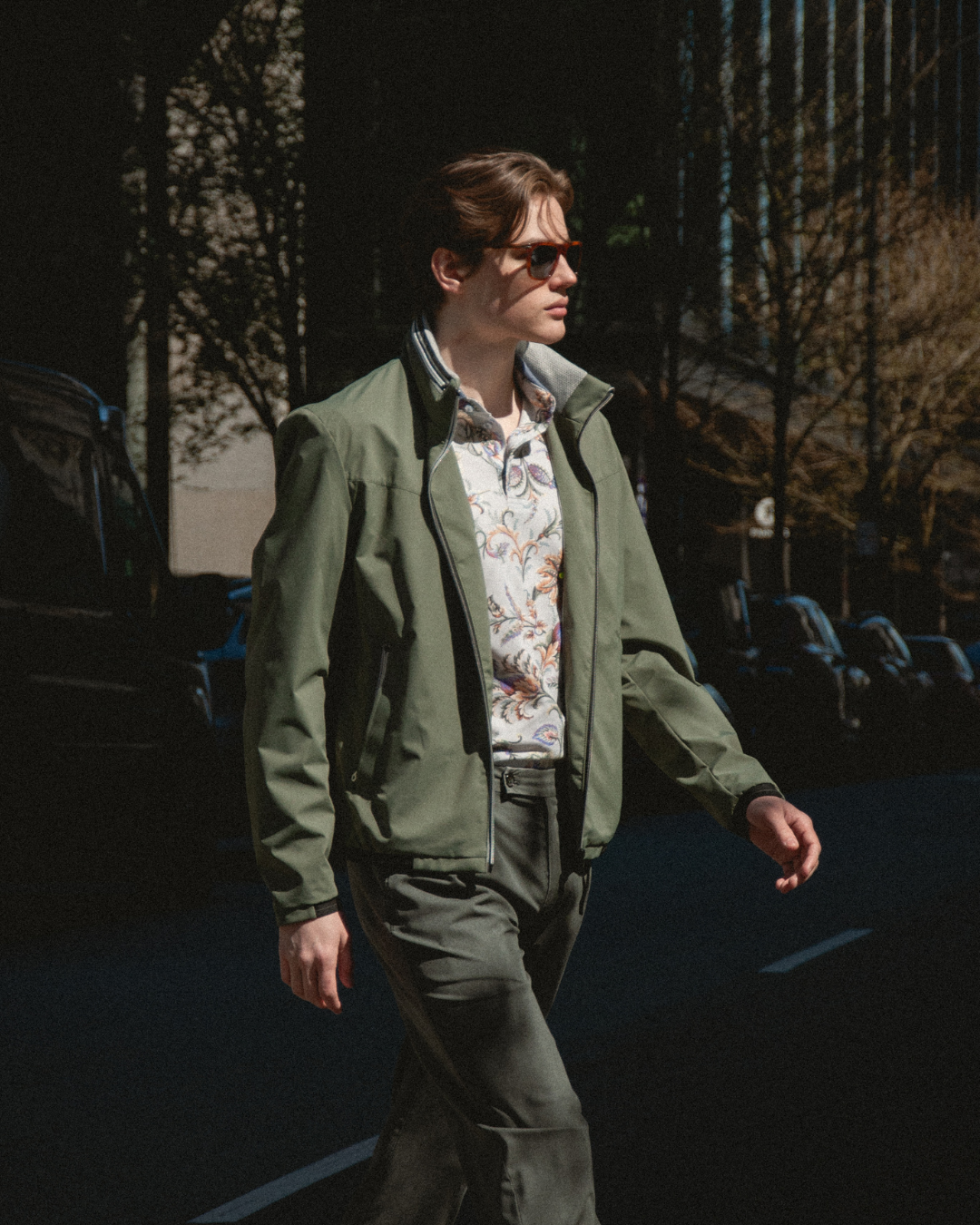
The waterproof bomber.
By Milestone, who have made jackets in Ingolstadt, Bavaria, since 1994. Short in the body, standing collar, light enough to go over a fine knit without bulk.
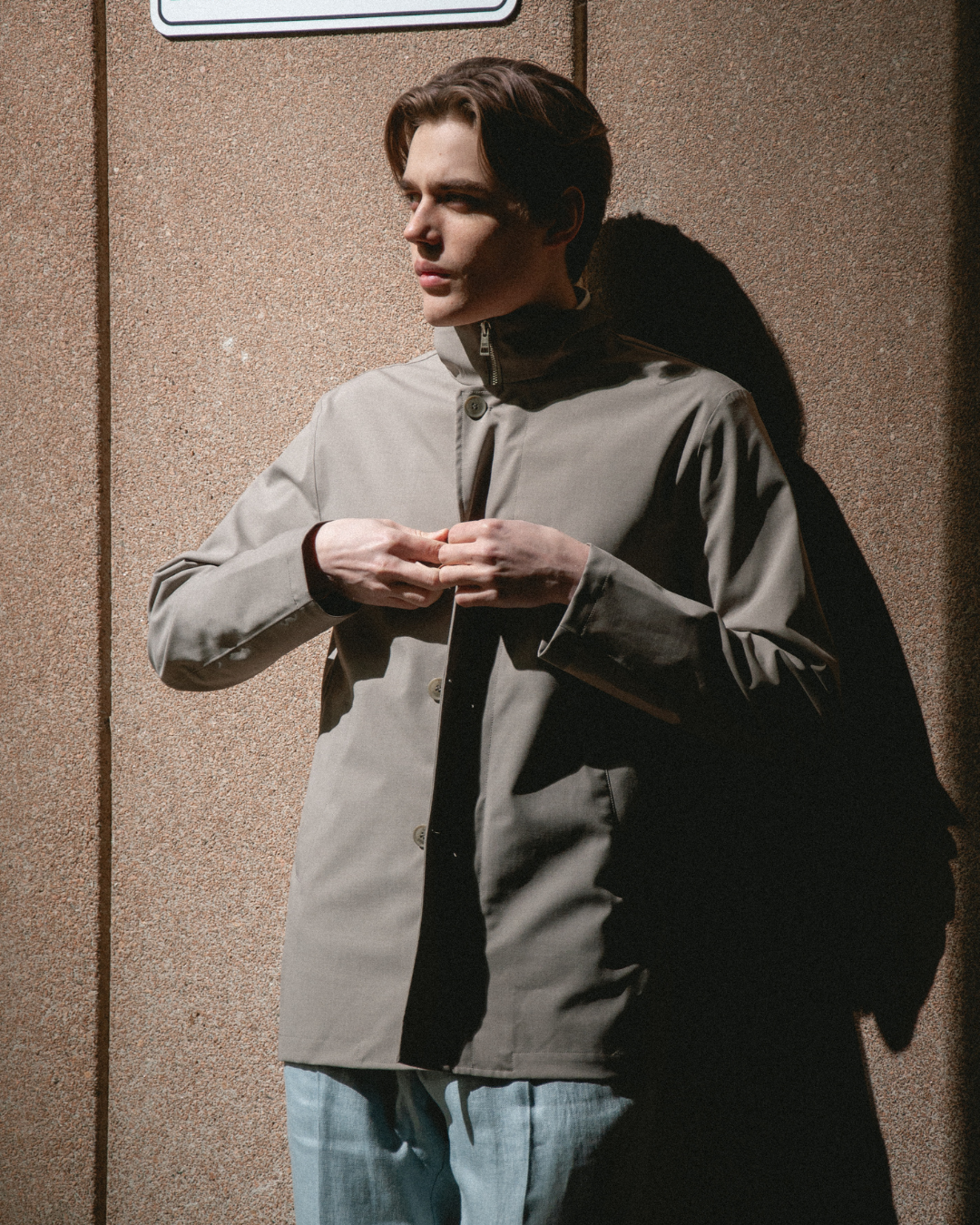
Technical jacket, taupe
By Duno, an Italian house founded in 2014 that makes outerwear and nothing else, with no visible logo on any of it. Taupe is what keeps this layer from reading as weather gear on a dry day.
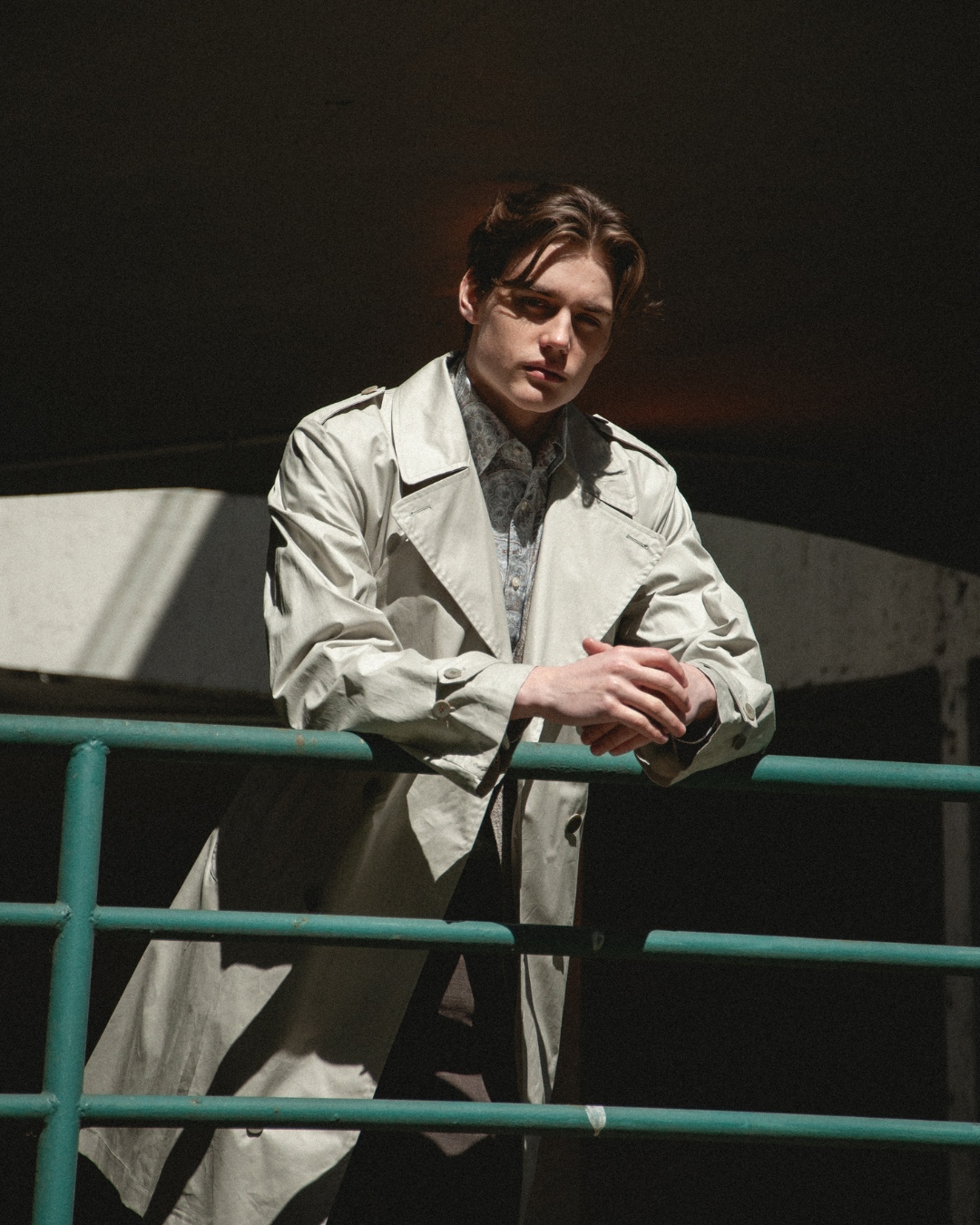
Vintage waterproof trench.
By L'Impermeabile, made by the Landi family in Empoli, in Tuscany, where raincoats have been produced since 1907 and where the family has worked since 1948. This is the one that goes over a suit.
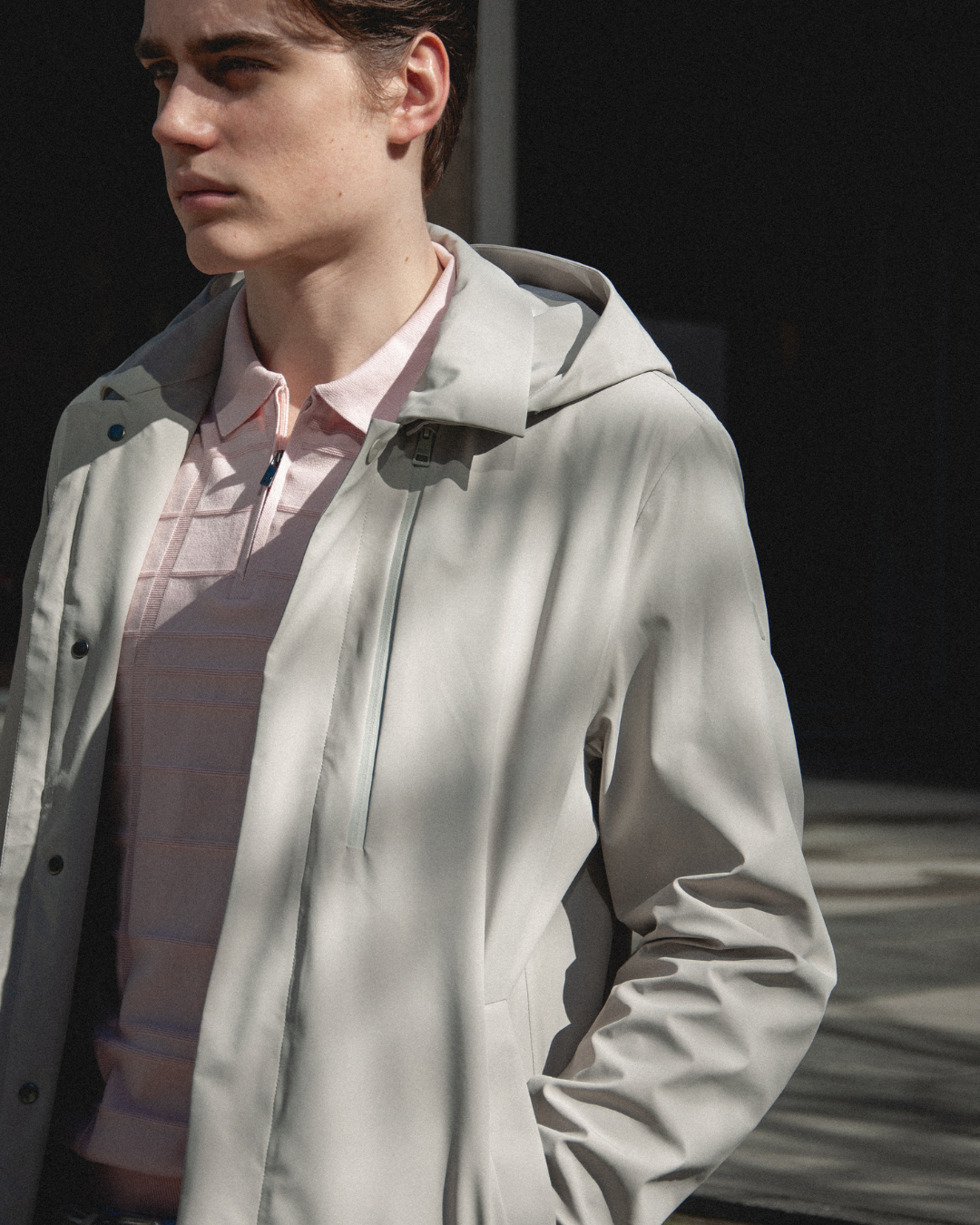
Hooded technical coat.
Also Duno. Longer than the others, and the hood is the difference: it is the one that handles standing at a crosswalk on Georgia in November rather than just getting you between doors.
What goes underneath
The jacket is the easy part. The layer under it is what men get wrong.
A fine merino knit works better than a heavy one, because the jacket is already holding warmth and a thick sweater turns the whole thing into November clothing in September. A polo or a shirt with some body to it holds its collar under a standing collar instead of collapsing.
Below, a wool trouser rather than a cotton chino. Wool sheds a light rain, keeps its shape when damp and dries without holding a crease where you sat down.
Looking after it
The water repellent finish on the face of technical cloth is not permanent. It goes at the shoulders and forearms first, where a bag strap and your own sleeves take the friction.
When water stops beading and starts soaking in, the jacket is not finished. It needs reproofing, which is a wash-in or spray-on treatment and, on most pieces, a low tumble or a warm iron through a cloth to reactivate it. Read the label. Once a season is usually enough here.
All four are on the floor now. The only reliable way to choose between them is to put your own jacket down, try each one over what you are actually wearing, and see which one you forget you have on. Come in at 525 West Georgia. There will be coffee, and no rush.